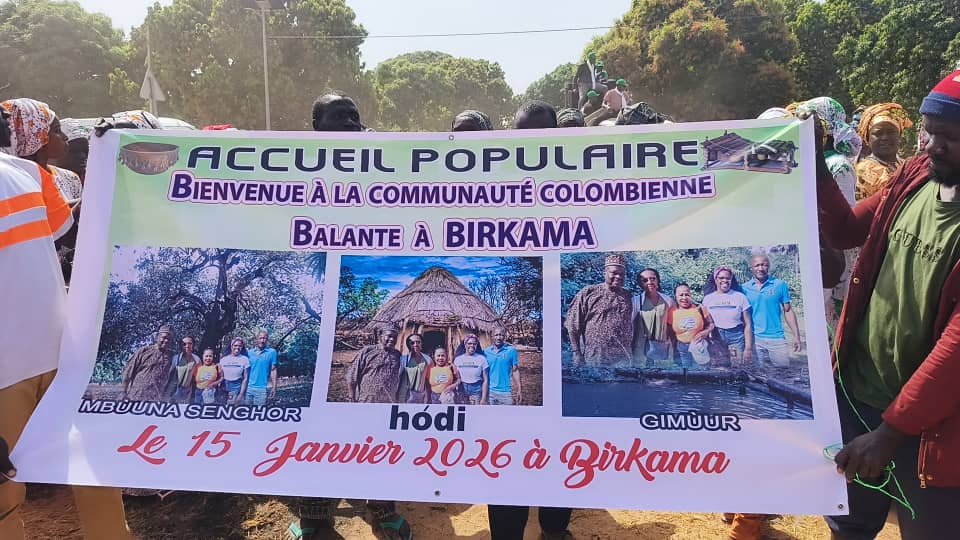
The Balanta community of Senegal, under the aegis of FABS (Federation of Balanta Associations of Senegal), welcomed their Colombian relatives who were on a cultural and fraternal pilgrimage (Framde) from December 31 to January 15 to the land of their ancestors. Indeed, a large community of Afro-Colombian Balanta lives in Colombia, particularly in the Valle del Cauca region in the southwest of the country. This is the region where the name Balanta is most common in Colombia (about 46% of people bearing this name live there). The community is mainly settled in major cities such as Cali, which hosts a large Afro-Colombian population with a predominance of Balanta families. They are also numerous in Cauca, Buenaventura, and Santander de Quilichao. Many people in these cities bear the surname Balanta. A smaller, scattered minority lives in Bogotá, the capital of Colombia.
These relatives from the other side of the Atlantic, who arrived in Senegal on December 31, were given a grand welcome by their brothers and sisters of the same blood. After a warm reception in Dakar by the Balanta community living in the capital and its surroundings, the guests traveled to Casamance. After a brief stay in the southern capital Zinguichor, they continued their journey of brotherhood through the Balantacounda and the Boudié, geographical areas that are home to the largest Balanta communities in Senegal.
In this part of the Sédhiou administrative region, the guests were first welcomed in Simbandi Balante on January 8. The reception began with visits to religious notables, followed by a discussion on traditional values. The following day, Mangaroungou received the guests. This included visits to sacred sites (ggala gleete), followed by presentations on Balanta funeral rites (Gi pbaa girij) and male traditional dances (njocta, nvul, etc.). On the third day, the village of Thianaff, located in Zone B, welcomed the pilgrims, who were guided to sacred sites before demonstrations of Giyura gi jaa and Gitaña gi jaa. On January 11, the journey continued to Diattacounda. In this village, Balanta communication and musical instruments were exhibited, along with a demonstration of the traditional healers’ dance (Niiré Bisigés).
After Diattacounda, the guests, together with the FABS delegation, crossed the Casamance River to reach the Boudié, notably the village of Kinthingrou, where they began, as customary, with visits to Balanta cultural heritage sites. These visits were followed by exhibitions and demonstrations of the traditional basket (Théré Fjaa) and traditional marriage (Brogdé Bjaa).
On January 13, they returned to the Balantacounda, specifically to Safane, one of the earliest Balanta settlement villages in Middle Casamance. After routine visits to sacred sites, demonstrations focused on the Dimbaya dance (Bidang ñiara or biwom boja) as well as Mmégés and bluf.
It should be recalled that Safane is historically a symbolic village for the Balanta. From this village, the great Balanta warrior Kouboune Sadio launched the assault that led to the conquest of the Bainouck kingdom and ultimately captured the capital, Birkama, in 1830. From this same village, many other Balanta villages were founded.
Djibanar took over after the Safane stage. Following visits to historical sites, a lecture was delivered by the academic Professor Noumo MANE on the theme: “The Balanta: from their origins to the present day.”
The village of Birkama marked the final stage on January 15, with outstanding mobilization and flawless organization. All of Balantacounda gathered for this major event in Birkama. Before the closing ceremony, which saw the participation of numerous customary, religious, and administrative authorities, exhibitions and demonstrations were held on Balanta gastronomy (culinary art) and the traditional Talante dance (fadung).
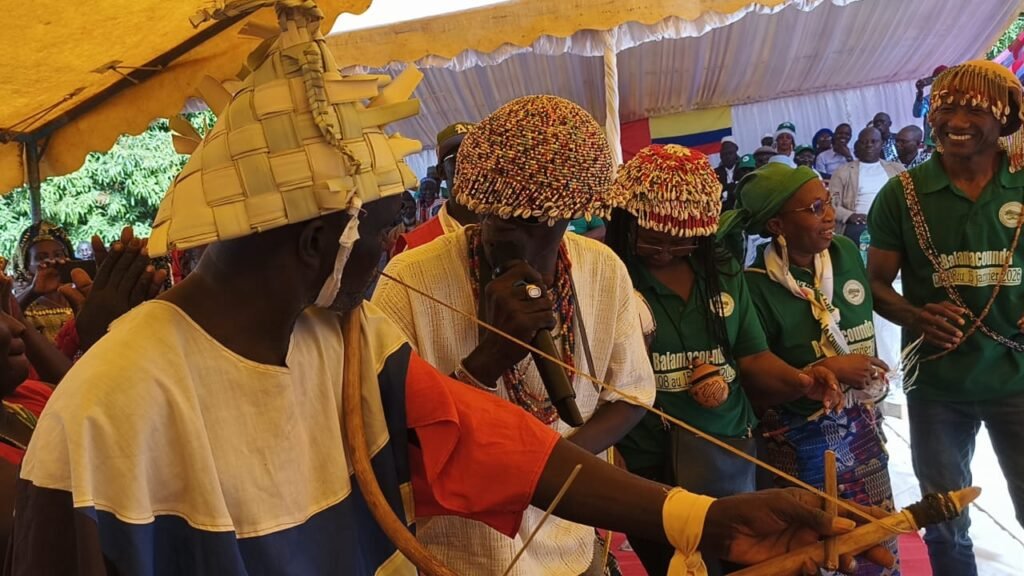
In conclusion, mobilization and organization were exemplary at every stage of the tour. The guests, who discovered the many facets of their culture, expressed great satisfaction. The villages that hosted these events with honor are historically and culturally symbolic for the Balanta, as they contain the most important historical and cultural heritage of the Balanta community of Senegal
By Youssouph Sadio


